
A common misconception is that a crypto wallet is mainly a digital container for coins. In practice, a DeFi wallet is closer to a signing interface for financial instructions. It helps a user connect to applications, select networks, approve contracts, and authorize actions that may be difficult to reverse. That distinction explains why the rabby wallet has attracted attention among users who move between Ethereum and its many EVM-compatible environments.
For German-speaking DeFi users, the appeal is not simply that Rabby supports many networks. The more important question is whether the wallet can make a complicated transaction understandable before the private key is used. Rabby’s central proposition is therefore an analytical one: simulate the proposed action, display the expected balance changes, and warn about recognizable risks before confirmation. This does not make DeFi safe by default, but it can improve the quality of the decision being made.
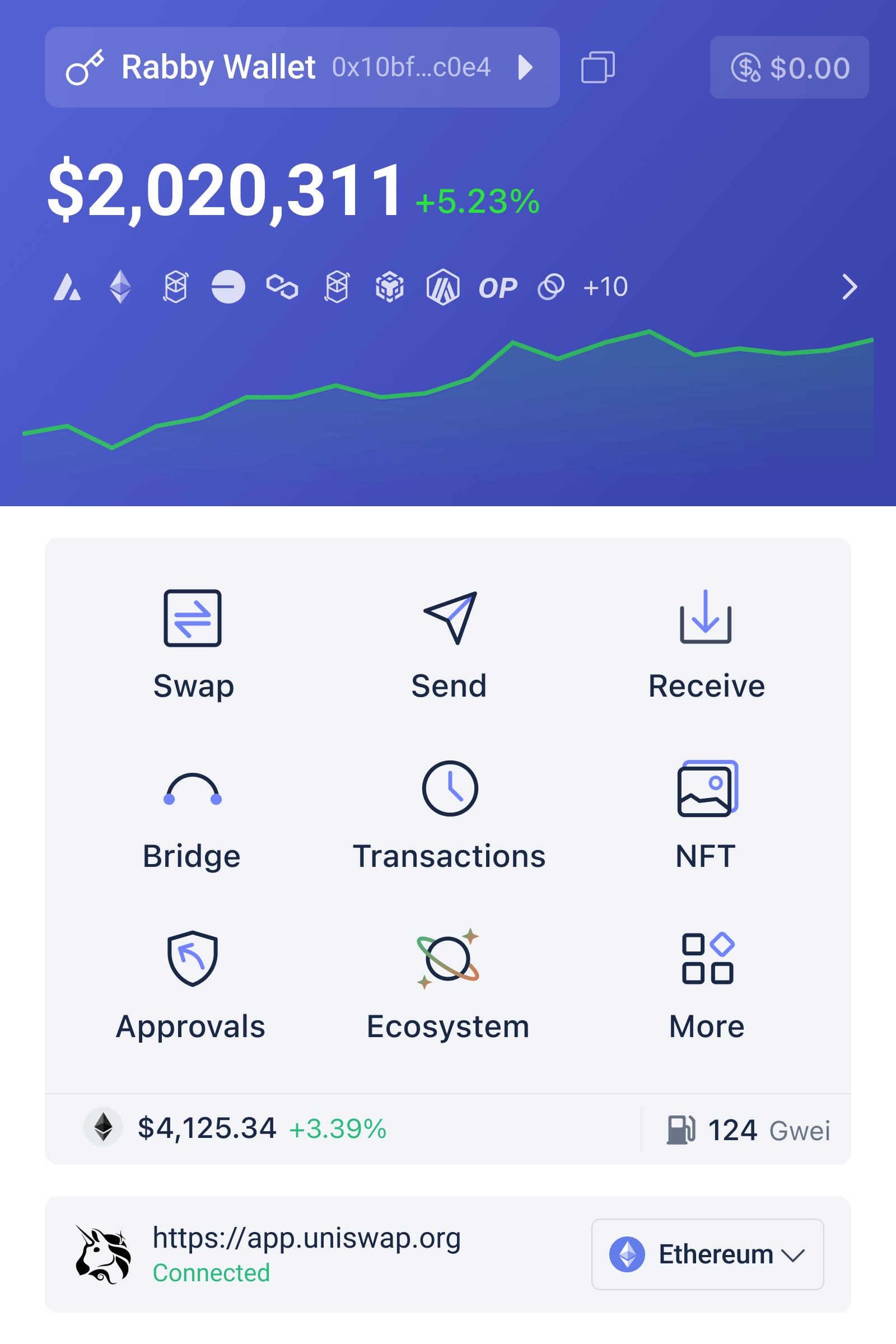
From account storage to transaction interpretation
Early wallet discussions often focused on custody: who holds the private key, and who can access the funds? That remains fundamental. Rabby is non-custodial, and its private keys are stored locally on the user’s device rather than transmitted to Rabby’s servers. Its software is also open source under the MIT licence, which allows the code to be examined by independent reviewers. Those properties create useful transparency and control, but they should not be confused with a guarantee against user error, malicious websites, malware, or a compromised device.
The category has evolved because DeFi introduced a different operational problem. A user may hold assets on Ethereum, Arbitrum, Optimism, Base, Polygon, Avalanche, or the BNB Chain and interact with protocols that require different permissions and gas assets. Rabby supports more than 140 EVM-compatible networks and can automatically switch to the network requested by a decentralised application. That removes a frequent source of friction, yet convenience has a boundary: automatic network selection does not prove that the connected application is trustworthy or that the selected chain is economically suitable.
This is where the wallet’s transaction simulation becomes conceptually important. A normal signing prompt can expose technical fields such as a contract address, method name, or encoded data. A simulation attempts to translate the proposed call into a more useful question: what should change in the account if this transaction succeeds? For a token swap, that may mean showing the tokens expected to leave and arrive. For an approval, it can draw attention to the amount and recipient. The user is not merely asked to recognise an address; the user is given a model of the likely outcome.
Simulation is a warning system, not a crystal ball
Simulation improves visibility, but it cannot eliminate uncertainty. It depends on the state of the blockchain, the behaviour of the contract, the quality of the underlying interpretation, and the assumptions used by the simulation environment. A transaction can also interact with changing liquidity, or be routed through several contracts. An apparently reasonable result may therefore deserve a second look when the amount is large, the protocol is unfamiliar, or the transaction involves a bridge.
Rabby complements simulation with a security engine that checks contracts and addresses for signals associated with phishing, known hacks, and unlimited token approvals. These warnings are valuable because many losses occur not through an exotic cryptographic failure, but through a user granting an overly broad permission to a malicious or compromised contract. Still, a warning engine generally works with known patterns and available information. New attacks, deceptive interfaces, or legitimate contracts with poorly understood behaviour may not be identified in time.
A practical mental model is to treat every wallet defence as one layer in a chain. The interface provides context; the scanner provides risk signals; simulation provides an expected outcome; the user verifies the application and amount; and a hardware wallet can protect the final signing step. Ledger, Trezor, and OneKey compatibility makes that layered approach possible. A hardware device helps protect the key, but it cannot determine whether the user is approving the wrong transaction. Strong custody and weak interpretation are still an unsafe combination.
Why the multi-chain experience changes the trade-off
Rabby’s direct comparison with MetaMask is best understood as a difference in emphasis rather than a claim that one wallet fits everyone. Rabby is designed around multi-chain DeFi workflows, with network detection, risk warnings, and a more explicit transaction review process. For a user who regularly moves between Ethereum, rollups, sidechains, and other EVM networks, reducing manual network changes can make routine work less error-prone.
That convenience also introduces a subtle risk: the smoother the workflow becomes, the easier it is to approve actions without pausing. Automatic switching, integrated swaps, and bridge access reduce operational friction. Rabby integrates bridge protocols such as LI.FI, and its swap aggregator can compare routes involving decentralised exchanges such as Uniswap and 1inch. Better routing may help with price and slippage, but a bridge or aggregator adds another layer of contracts and dependencies. The best rate is not automatically the lowest overall risk.
The Gas Account feature illustrates the same balance. Paying network fees with stablecoins such as USDC can be useful when a user holds funds on a chain but lacks its native gas token. This is particularly practical for occasional users and for portfolios spread across several networks. Yet fee abstraction can hide the economic structure of a transaction: there may still be service conditions, conversion mechanics, or network-specific limitations. Users should check the final cost and asset flow instead of assuming that “paying in USDC” means the transaction is free from additional complexity.
For everyday use, a simple decision framework is more valuable than a long feature checklist. First, identify the action: transfer, swap, approval, bridge, or contract interaction. Second, inspect the simulated balance changes and ask whether they match the intended result. Third, examine approvals and recipients, especially when an application is new. Fourth, consider whether the transaction crosses a bridge or depends on several protocols. Finally, use a hardware wallet and a smaller test amount when the consequence of error would be material.
What the current direction suggests
Recent Rabby messaging presents the product as a broad wallet for Ethereum and EVM activity, available primarily as a browser extension for Chrome, Brave, and Edge, alongside desktop software for Windows and macOS and mobile applications for iOS and Android. The direction is clear: wallets are becoming operating layers for on-chain activity rather than passive account viewers. Features such as swaps, bridges, gas management, and loyalty points bring more activity into one interface.
The open question is whether consolidation improves safety or merely concentrates more decisions in a familiar screen. If simulation becomes more accurate and warnings become more context-aware, wallets could serve as practical interpretation tools for complex smart-contract interactions. If convenience outpaces user understanding, the opposite may happen: people may approve more because the workflow feels polished. The useful signal to watch is not the number of supported chains, but whether the interface consistently explains consequences, limitations, and uncertainty before signing.
Rabby is therefore best judged neither as a magic shield nor as just another MetaMask alternative. Its strongest contribution is the attempt to make transaction intent visible at the point where a user must decide. For DeFi participants in Germany and elsewhere, that can be a meaningful improvement, especially across many EVM networks. The discipline remains the same, however: verify the application, review the outcome, minimise permissions, protect the signing device, and treat every automated convenience as assistance rather than proof of safety.
Frequently asked questions
Is Rabby Wallet safer than other browser wallets?
It offers several safety-oriented features, including transaction simulation, contract and address warnings, local key storage, open-source code, and hardware-wallet support. These features can reduce some common mistakes, but they do not protect against every threat. A malicious website, compromised computer, inaccurate interpretation, or careless approval can still create losses.
What does Rabby transaction simulation actually show?
Before signing, Rabby simulates the proposed transaction and presents the expected changes to token balances. This can help users distinguish a genuine swap from an unexpected transfer or identify an approval that grants excessive access. The result is an estimate based on available blockchain state, not an absolute promise that the final transaction will behave identically.
Can Rabby be used with hardware wallets?
Yes. Rabby supports hardware wallets including Ledger, Trezor, and OneKey. This separates transaction review from private-key protection: Rabby can help explain what is being signed, while the hardware device keeps the key isolated. Users should still verify the transaction details on the hardware device where possible.
Does Rabby work only on Ethereum?
No. It is built for Ethereum and EVM-compatible networks, with support for more than 140 chains and networks, including Arbitrum, Optimism, Base, Polygon, Avalanche, and the BNB Chain. Automatic network switching simplifies access, but users should still confirm that the application and network are the ones they intended to use.